Recipes
Every year in November the same search goes up: alternatives to turkey. People want something with more flavour, less dryness and a bit of occasion, and the answers are always the same list. Beef, lamb, venison, duck, goose.
Goose is the one I would push you towards, and the one I cook for my own family. It was the Christmas bird in this country for centuries before the turkey turned up, it has dark, rich meat that tastes of something, and it comes with a bonus most people throw away: a litre of the best roasting fat in the world. The catch is that in a domestic oven it is a fight, because all that fat has to go somewhere. Over a fire, it goes into the embers and comes back up as flavour. That is why goose and fire belong together.
Take the giblets out and keep them for gravy. Pull the big lumps of pale fat from inside the cavity and set them aside; they render down into a jar of fat you will use until Easter. Prick the skin all over with a skewer, especially around the legs and where the breast meets the thigh, going through the skin and fat but not into the meat. This is what lets the fat escape.
Then pour a kettle of boiling water over the whole bird, pat it completely dry, salt it heavily inside and out, and leave it uncovered in the fridge overnight. The scald tightens the skin, the salt seasons the meat, and the dry air sets you up for crackling-crisp skin.
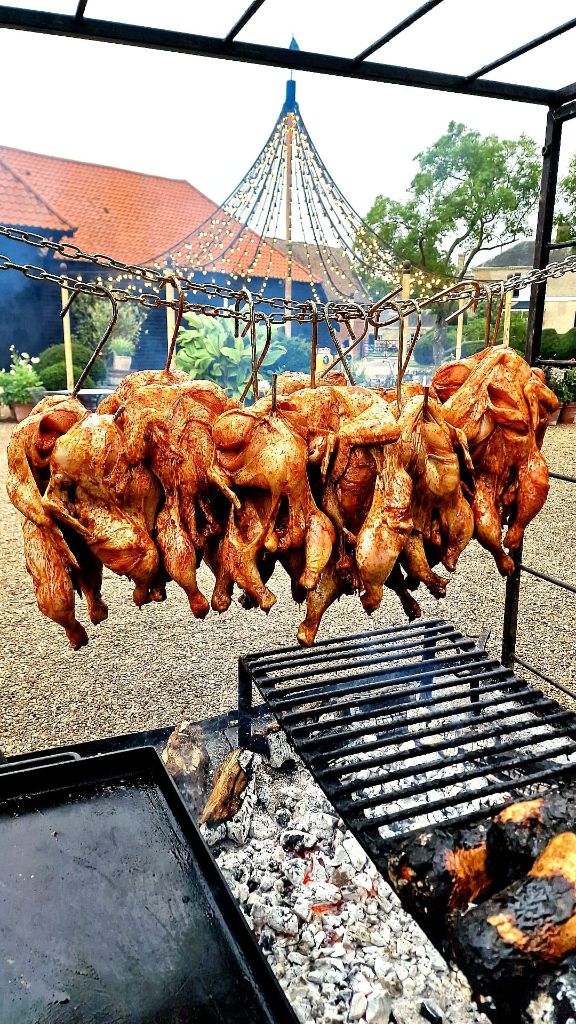
Goose wants a long, gentle, indirect cook and then a short, fierce finish. So: a big bed of embers built up at one end of your fire, and a cooler zone at the other, with the bird nowhere near direct flame for most of its life. If you have a rotisserie or can rig a spit, this is the bird to use it on; the constant turning bastes it in its own fat and gives even skin all round. If not, a grate in the cool zone with a drip tray underneath works, turning the bird every half hour.
Use oak or beech for the embers. Fruitwood on top for the last hour if you have it; apple smoke on goose is one of the great Christmas smells.
The first goose I cooked over a fire I lost half the fat into the embers because I had no tray, and the smoke could be seen from the next village. The bird was still the best Christmas dinner anyone there had eaten. Put a tray under it and you will have both the bird and the fat.
- Cai
Potatoes. Parboiled, roughed up, into a tray of goose fat on the hot side of the fire until they shatter. This is not a side dish, it is the reason people come back. Then jar the rest; it keeps in the fridge for months and makes the best roast potatoes, fried bread and confit you will ever cook.
Goose is rich, so everything around it should be sharp or bitter. Red cabbage braised with apple and vinegar. A sauce of the giblets, stock and a glass of port, sharpened with a spoon of quince or redcurrant. Sprouts charred on the stalk over the embers, which is the only way I will eat them. Bread sauce if you are traditional, which at Christmas I am.
If you would rather not cook it yourself, a whole goose on the spit is one of the centrepieces of a winter feast with us, and the technique is one we teach at a December workshop. But honestly, try it. It is harder to get wrong on a fire than in an oven.