Recipes
A raised game pie, cut on Boxing Day with a bowl of pickles, is as good as British food gets. Golden hot water crust, a dense filling of mixed game and pork, a layer of jelly between the two, and a crust that stands up on its own without a tin. It is the pie our Game Pie Workshop is built around, and it is the thing people most often tell me they are scared to try at home.
You should not be. It takes an afternoon, a few techniques that are easy once you have seen them, and a bit of patience while it cools. This is the whole method.
You want about 1kg of filling for a pie that feeds eight. The classic is mixed game with pork for fat, because game on its own is lean and will make a dry pie.
Mix it all by hand, hard, until it is tacky and holds together. Fry a teaspoon of it and taste it. Adjust. This is your only chance to get the seasoning right; you cannot fix it once it is in the crust.
This is the pastry that frightens people and it is the easiest pastry there is. It has no technique beyond working quickly while it is warm.
You can do this in a loose-bottomed tin, which is forgiving and what I recommend the first time, or hand-raise it around a jam jar, which is the traditional method and what we do at the workshop once people have the feel of the pastry.
Either way: roll the warm pastry to about 5mm, line the tin (or drape it over the jar and mould it up the sides), and make sure there are no thin spots or cracks. Pack the filling in firmly, mounding it slightly in the middle. Roll the lid, brush the rim with beaten egg, press the lid on and crimp hard. Cut a hole in the top the size of a pound coin. That hole matters; it is where the steam gets out and the jelly goes in.
Brush the whole thing with egg. Decorate if you like. I do not, much.
Hot for 30 minutes at 200C to set the crust, then down to 160C for another hour and a half. If you are doing this in a wood-fired oven or in cast iron on the fire, which is how it was done for most of its history, you want a fierce start and a long, gentle finish, and you will need to turn it. A probe in the centre should read 75C when it is done. If the top is colouring too fast, lay foil over it.
Let it cool in the tin for at least an hour before you go anywhere near it.
The filling shrinks as it cooks and leaves a gap under the lid. The jelly fills it, seals the meat and is the thing that makes a slice of game pie look the way it should.
Make a stock from the game bones and trimmings (or use good chicken stock), reduce it hard, season it, and set it with gelatine: about three leaves to 300ml, soaked, then dissolved in the warm stock. Let it cool until it is just liquid. Then, using a small funnel in the hole in the lid, pour it in slowly, a little at a time, until the pie will take no more. Fridge overnight.
Two things collapse a game pie. Pastry that was worked cold and cracked without you noticing, and a filling that was packed loosely so it slumped away from the wall. Work the pastry warm and pack the meat like you mean it, and the sides will stand.
- Cai
Cold, the next day, in thick slices. Piccalilli or a sharp chutney, a few cornichons, a bit of mustard. Nothing hot. A pie like this is a cold dish and it is better for having sat overnight.
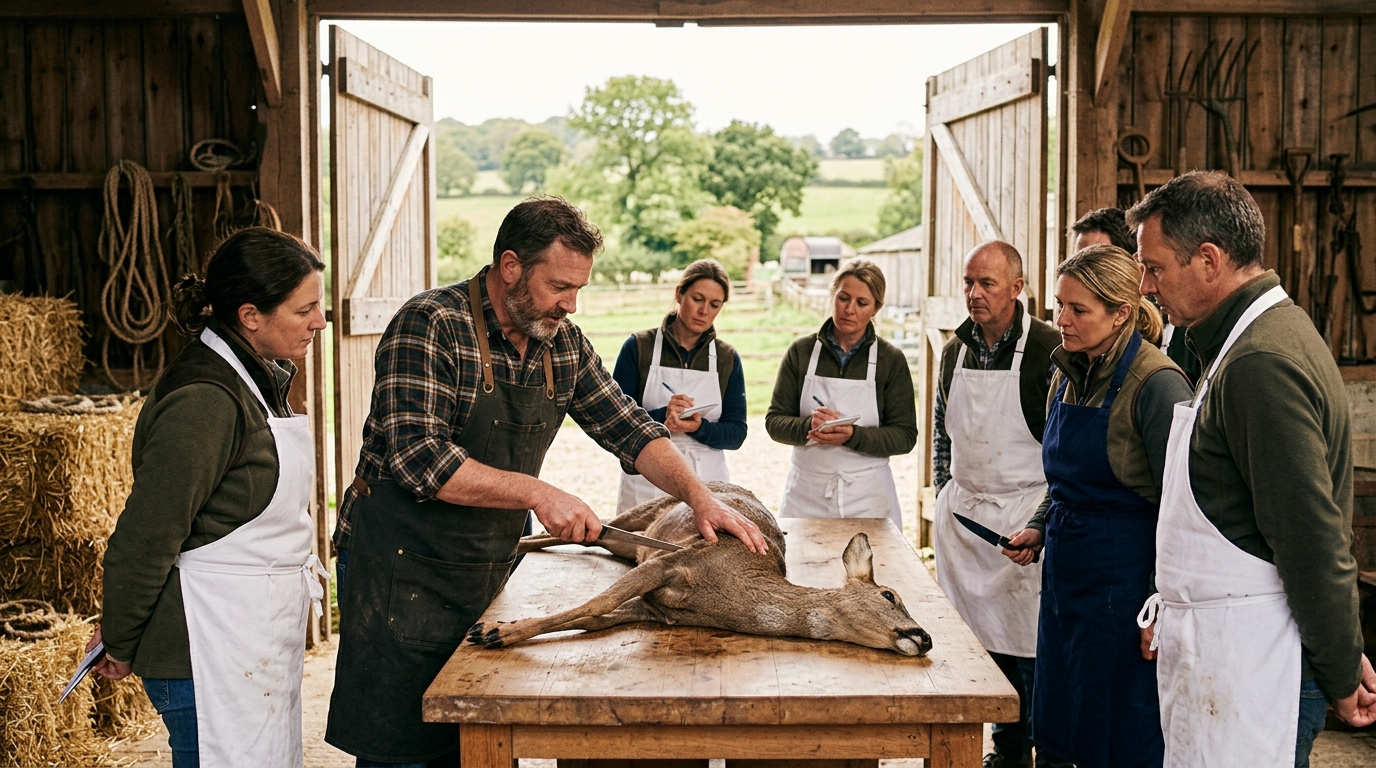
If you would like to make one with someone standing next to you, that is exactly what the Game Pie Workshop is: an afternoon at our base in Hooe, the pastry, the filling, the raising, and you take your own pie home. The next one is Sunday 20 December, which is nicely timed for Boxing Day.